
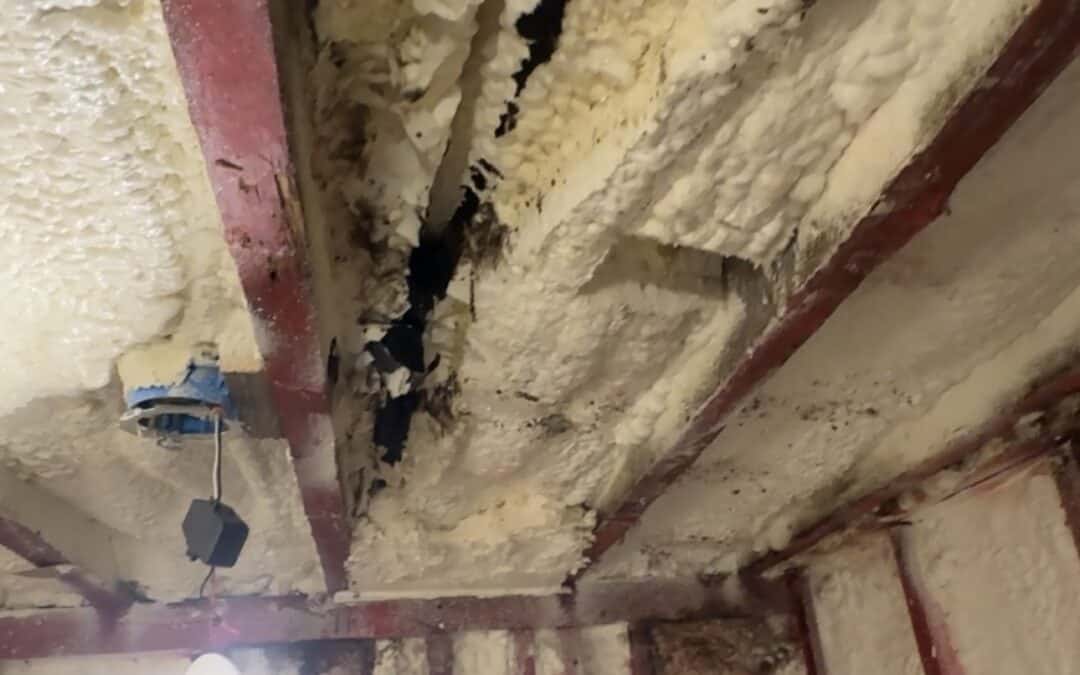
A homeowner in Mid-City called me this summer. His wife had found mold growing on her clothes in the closet that shares a wall with their wine cellar. When he went into the cellar to look, the ceiling was dripping.
He has 3,000 bottles in that room. He knows what mold does to a cork. So this was not a small problem to him.
The cellar was about five years old. It was built before they bought the house, so they inherited it. They vaguely remember someone coming out early on to fix a spot, but they cannot remember what it was. That is usually the first sign. The room was already failing and somebody patched the symptom.
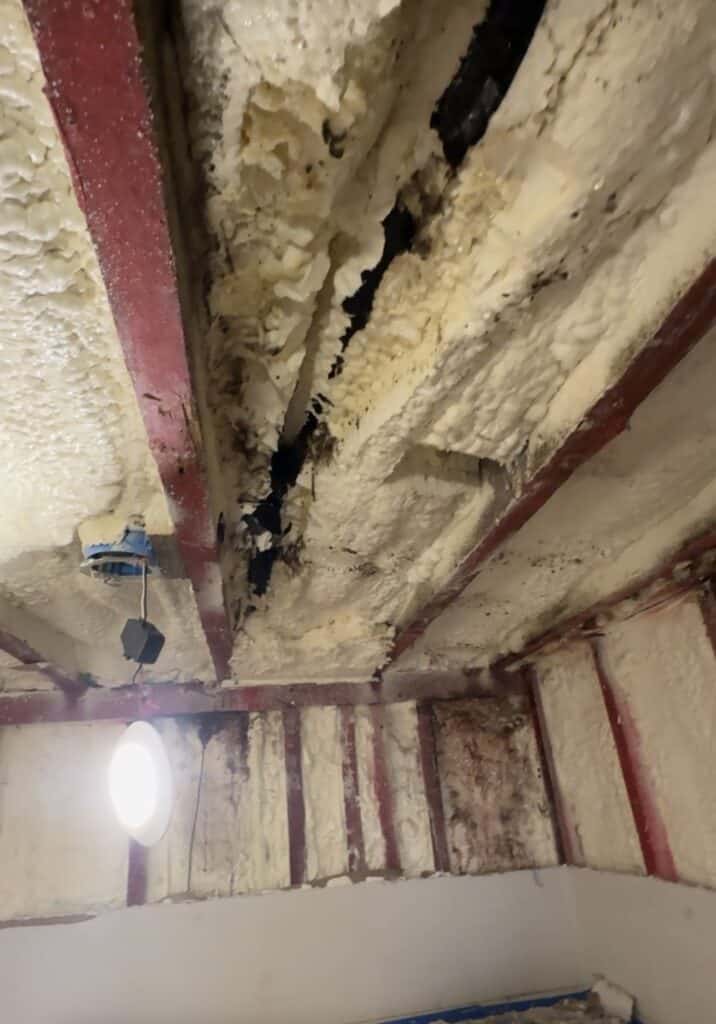
WHAT WE FOUND WHEN WE OPENED THE WALLS
Every square inch of that ceiling was covered in water. Not damp. Running with it.
Black mold ran down from the ceiling about a foot onto the walls. We had to bring in dehumidifiers before we could do anything else, just to dry the room out enough to work in it.
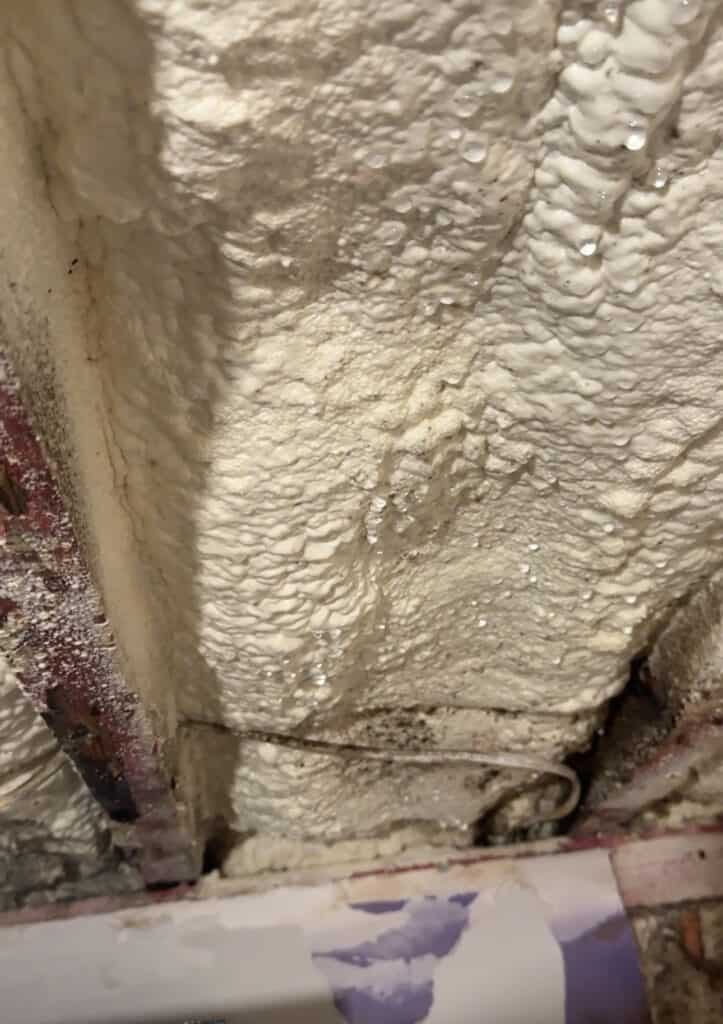
The thing is, before we opened it up, that cellar looked fine. It looked like a nice room. To a homeowner, and honestly to most general contractors, it looked like it had been built right.
WHY IT HAPPENED
Your wine cellar is the only room in your house that is cold and damp on purpose. Fifty five degrees, around sixty percent humidity, year round.
This house was built around 1910. The cellar is on the second floor with an attic above it. In August that attic runs well over a hundred degrees and it is full of moisture. Warm wet air always pushes toward cold. So that attic air is pushing on your cellar every hour of every day.
If that air finds a way into the wall or the ceiling assembly and touches something cold, it drops its moisture right there as water. That is it. That is the whole problem.
Your bedroom wall never has to deal with this, because both sides of it are about the same temperature. Your cellar wall deals with it constantly, for years, and you cannot see any of it happening.
WHAT THE BUILDER ACTUALLY GOT WRONG
He used closed cell spray foam, which is the right product. That is what makes this case worth writing about. He spent the money on the expensive answer and still ended up with twenty thousand dollars of damage.
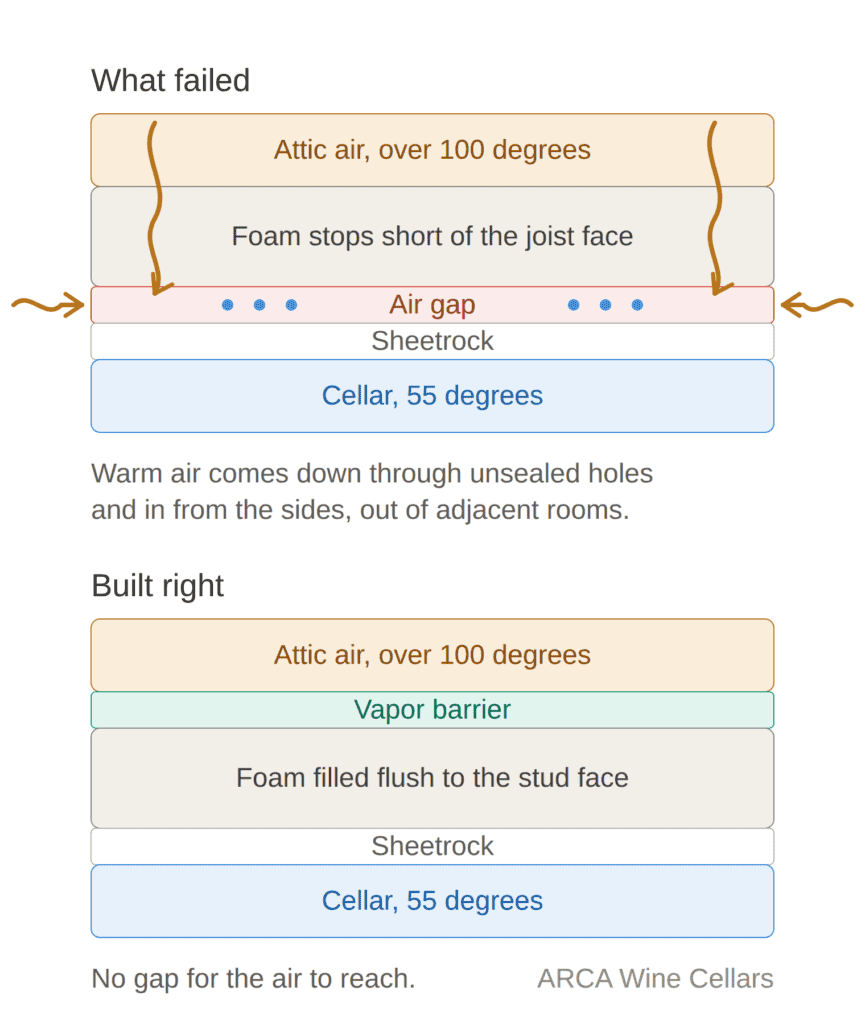
The ceiling joists were about eleven and a half inches deep. He filled them, which takes several passes. But he did not bring the foam all the way down flush with the face of the joists. He left it short.
That left an open cavity between the foam and the back of the sheetrock. Then there were holes drilled through the top plate for electrical that were never sealed. So hot attic air from the rooms around it ran straight into that cavity and sat there.
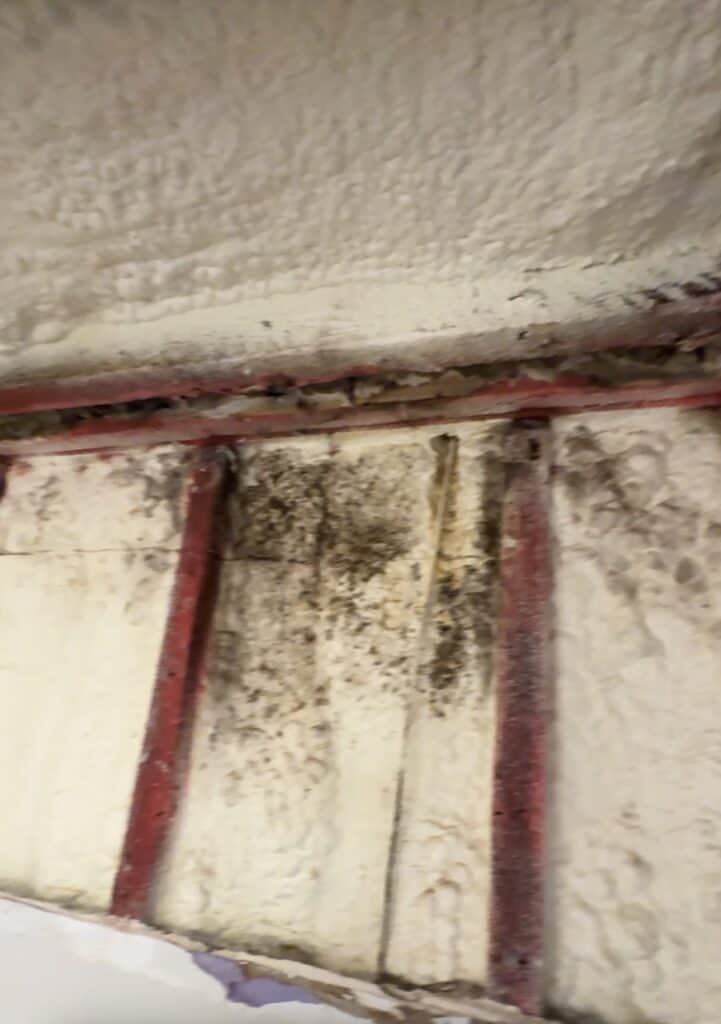
Meanwhile the cooling unit is mounted high in the cellar, over the door, blowing cold air directly against that same sheetrock.
So you have hot wet air on one side of a piece of sheetrock and cold air blowing on the other. He built a condensing surface without meaning to.
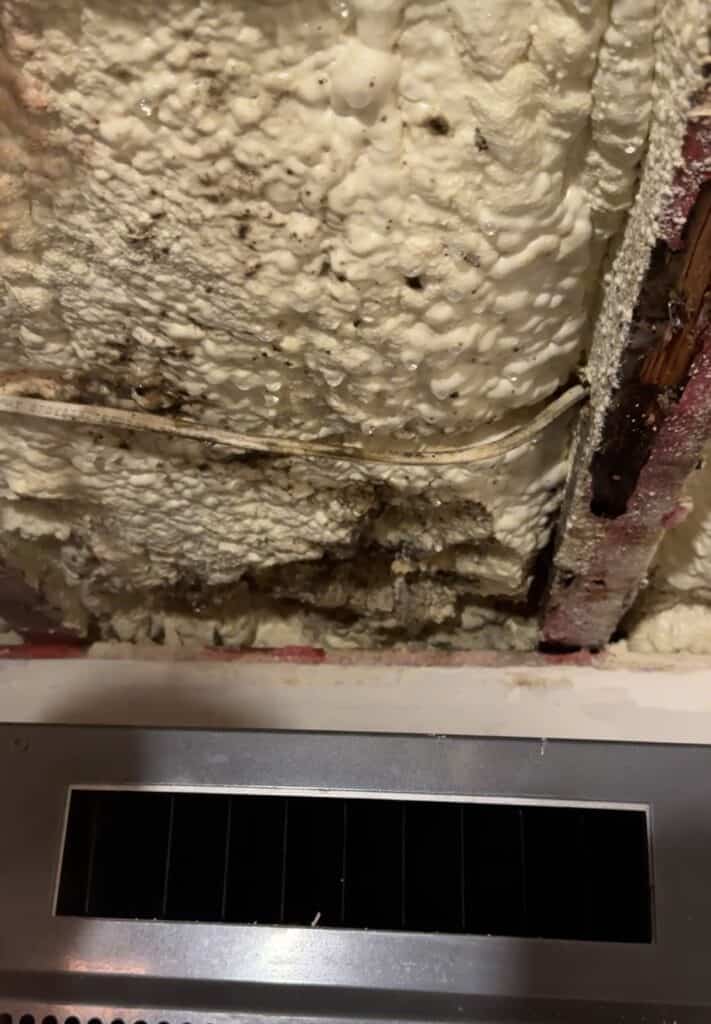
There was also no vapor barrier anywhere in that assembly. He relied on the foam alone.
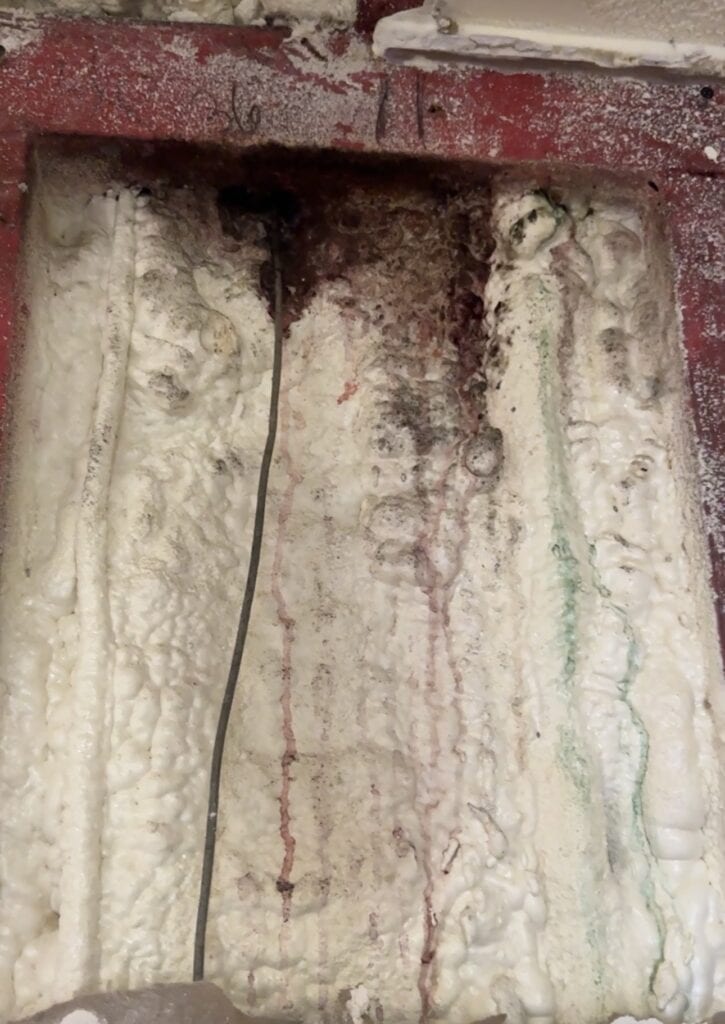
Worth knowing: mold does not much like growing on closed cell foam. It loves wood. So it takes hold on the studs and joists, which are organic, and then spreads onto the foam surfaces next to them. Using foam does not make a room mold proof. It just changes where the mold starts.
A few smaller things we found, none of which caused this, but all of which should have been done better:
The refrigerant line set penetration into the attic was not sealed. Warm air was getting trapped inside the pipe insulation and chasing up into the attic, making condensation up there too. Same mistake as the top plate, different hole.
The can lights throw off too much heat for a room like this. We are swapping them.
The door is a solid wood door that was retrofitted into the opening. Not ideal. Not what caused this.
He also coated the joint between the top plate and the wall assembly with a liquid tile waterproofing product, which tells me he knew that joint mattered. It was the wrong material for a cold room, and it would not have saved him anyway. You cannot seal your way out of an unfilled cavity and open holes in the top plate.
HOW IT SHOULD HAVE BEEN BUILT
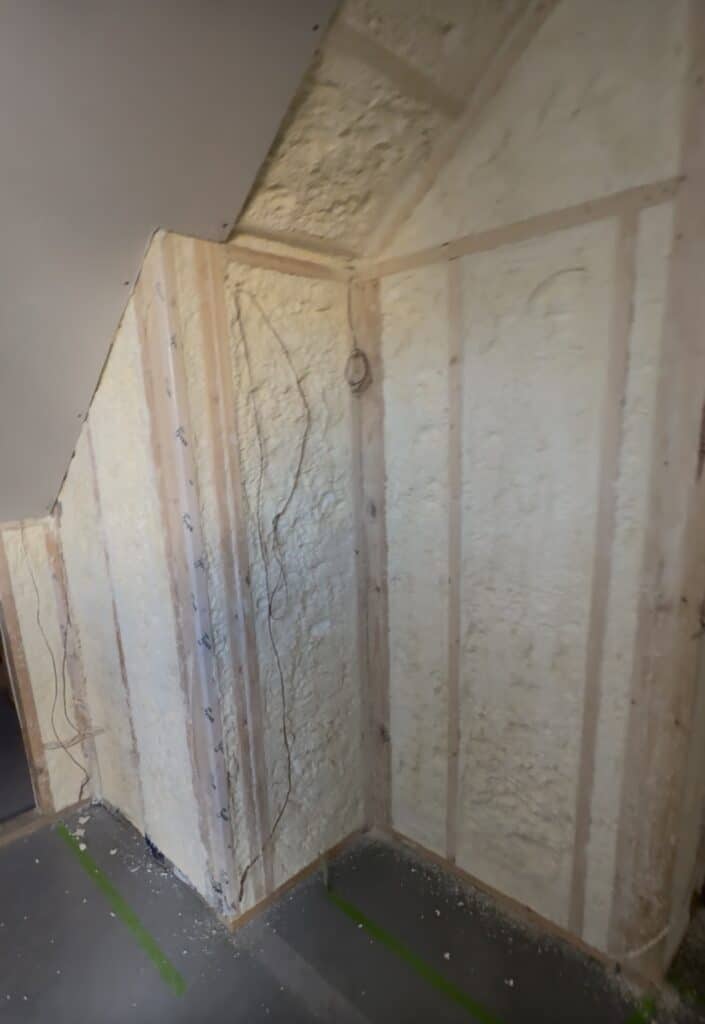
Vapor barrier on the back side of the cellar studs. Foam brought all the way out flush with the inside face of the studs and trimmed flat, at least four inches. A liquid vapor barrier made for this application anywhere plastic cannot run continuously. Every single penetration sealed, every hole in the top plate, every wire, every line set.
On the ceiling you go past the footprint of the room. If the cellar ceiling is six by six, you foam eight by eight in all directions. Air leaks in at the corners where the top plate meets the ceiling. You have to get out ahead of it.
This is what it looks like when it is done right.
THE PART THAT SHOULD BOTHER YOU
This repair is costing the homeowner around twenty thousand dollars.
Doing it right the first time would have cost that original contractor maybe five hundred dollars in materials and one extra day of labor.
That is the whole story. It is not an expensive thing to do correctly. It is a knowledge problem, not a money problem. A lot of contractors read a few articles, build the room, and figure close enough will hold. In most rooms close enough does hold. In a wine cellar, one missed hole in a top plate will destroy the wall.
There is another reason the number is that high. We could not remove the failed insulation. It is bonded to the back of the sheetrock in the bathroom and the closet next door, and pulling it out would have taken those finished rooms with it. So the bad work stays where it is, sealed off behind plastic, and we built a correct wall and ceiling in front of it. You are not fixing it. You are burying it and starting over in front of it.
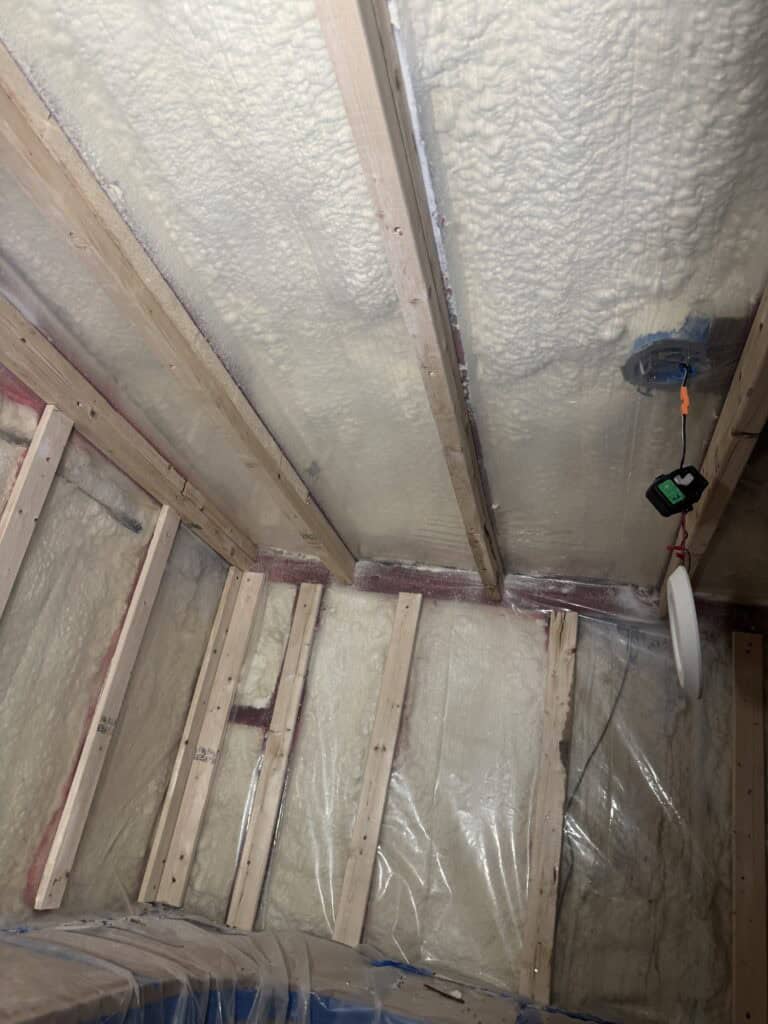
The repair takes about two weeks and it is miserable for the homeowner. We boxed all 3,000 bottles and moved them into his bedroom, because two weeks is survivable and finding offsite storage for that many bottles is not. He was not happy about it. There was no better option.
WHAT TO ASK BEFORE YOU HIRE ANYBODY
Most homeowners do not know to ask any of this. That is the reason I am writing it down.
Have you built a wine cellar before, and can I see it? Not a remodel. A cellar.
What is your process for preventing condensation? You want to hear him talk about a vapor barrier and which side of the studs it goes on. You want to hear foam flush to the stud face. You want to hear that the ceiling extends past the footprint of the room. You want to hear about sealing penetrations. If he says “we use spray foam” and stops there, that is your answer. That is exactly what happened in Mid-City.
Will you warranty it, and for how long? Ask specifically about moisture forming behind the walls. Nobody warranties a room he does not understand.
For what it is worth, we warranty our cellars. If something goes wrong, we come back and fix it.
IF YOU ALREADY HAVE A CELLAR, GO LOOK AT THIS TODAY
Look at your can lights. Condensation or dripping on the light housings is an early sign.
Look for water staining on the ceiling, and on the ceiling of whatever room sits below the cellar.
The best check is a thermal imaging camera scanned across the top half of the walls and the ceiling. Temperature changes up there tell you what is happening inside the wall before anything shows on the surface.

Smell the room. A musty or mildew odor is a real signal, but there is a catch. If it is your cellar, you have gone nose blind to it. You walk in every week and you do not notice. Ask somebody who has never been in there to tell you what they smell.
The failure you can see is always late. By the time it is dripping, the wall has been wet for a long time.
A note on mold. We do not do mold remediation. That work has to be done by a licensed remediation company, and the homeowner hires them directly. We can point you toward companies we have worked with. Once the room is cleared, we rebuild it properly.
We build and rebuild wine cellars all over New Orleans. Uptown, Mid-City, the Garden District, Metairie, and across the Northshore.